
More than 200 people associated with the energy industry—including government officials, academics, and representatives from the private sector—attended the seminar “Regulatory Challenges in Energy 2026–2030,” held at the main campus of the Catholic University.
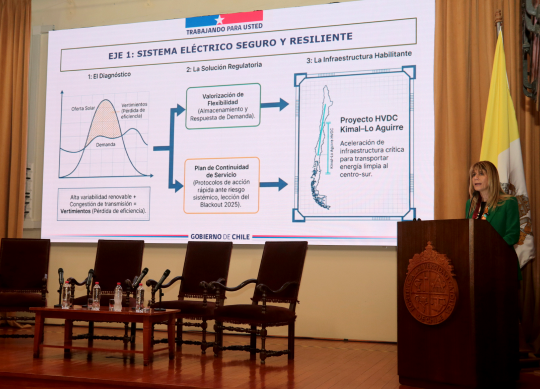
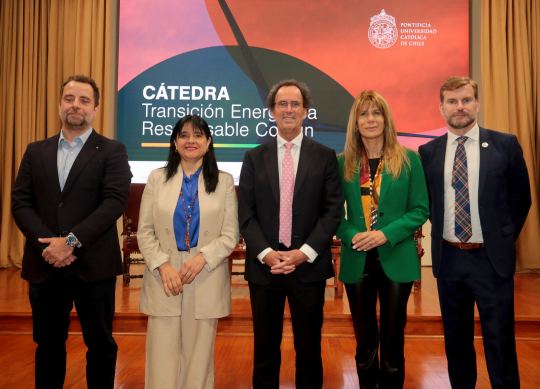
More than 200 people from the energy industry — including authorities, academics, and private sector representatives — participated in the seminar “Regulatory Challenges in Energy 2026-2030,” held at the Universidad Católica Main Campus.
The meeting was defined by a central challenge: Chile is entering a new phase of its energy transition, where growing renewable capacity is no longer enough — it is now essential to resolve structural problems of reliability, integration, and market design.
Santiago, April 9, 2026. As part of the Colbún Responsible Energy Transition Chair — a joint initiative between the power generation company and the Pontificia Universidad Católica de Chile — the seminar “Regulatory Challenges in Energy 2026-2030” was held today, focusing on the main regulatory changes, adjustments, and projections for Chile's energy sector, together with authorities and industry experts.
The event opened with remarks from Universidad Católica Rector Juan Carlos de la Llera, followed by presentations from Minister of Energy Ximena Rincón and Colbún CEO José Ignacio Escobar. A conversation panel moderated by Paulina Basoalto, Colbún's Regulatory Manager, brought together Marta Cabeza, Superintendent of Electricity and Fuels; Matías Negrete, professor at the UC School of Engineering; and the company's CEO.
Minister Rincón addressed the sector's main regulatory challenges, emphasizing the need to move toward a more reliable, transparent, and aligned system in line with energy transition demands. “Regulation cannot react late or be merely reactive. We must anticipate, coordinate the different actors, and build a safe and resilient electricity system that responds to the country's needs,” she stated. She also stressed that one of the central priorities is advancing the simplification and strengthening of tariff-setting processes. “We need serious, timely, and reliable processes. We cannot keep accumulating delays and errors that end up directly affecting families,” she affirmed.
Regarding system challenges, Rincón referred to the distortions present in the Small Distributed Generation (PMGD) segment. “The current system generates significant distortions. The price stabilization mechanism has led to excess costs ultimately borne by customers, and we must correct this while safeguarding the confidence of those who have invested,” she emphasized.
Universidad Católica Rector Juan Carlos de la Llera highlighted the importance of the event. “This Chair is a key space for addressing the sector's challenges. Energy security is a matter of national sovereignty, and Chile's electricity system requires adequate regulatory frameworks to address current phenomena and ensure reliable and sustainable development,” he noted.
Colbún CEO José Ignacio Escobar stated that the country is facing unprecedented challenges at the international level. “Chile was a global benchmark in the design of its electricity system, and today we are once again at an inflection point, where we must demonstrate that we are capable of building the electricity markets of the future,” he expressed.
The executive also emphasized that Chile's electricity system has advanced rapidly in decarbonization, far exceeding original targets — with more than 60% renewable generation by 2025 against an original goal of 10% — but warned that this very success has created new tensions: “we have made extraordinary progress in renewable energy, but along the way we have placed fundamental attributes such as security, resilience, and system stability in the background.”
Escobar went further, noting that “today the country faces a structural paradox: an abundance of energy, yet with trust issues in the system. We cannot have a sector with this installed capacity while users do not trust that supply will be safe and continuous.”
Conversation Panel: Regulation and Future Challenges
The conversation panel addressed various challenges related to energy regulation and the transition toward a more sustainable electricity system.
Marta Cabeza, Superintendent of Electricity and Fuels, highlighted the central role of users in the system: “our challenge is to ensure quality, continuity of supply, and timely responses with real-time information,” she noted. She also emphasized lessons learned from recent events. “Outages can happen, but the key is fast and adequate recovery for users,” she specified. She further underscored the importance of developing the human capital needed to accompany this energy transition, since behind this entire process, ultimately, are people.
Matías Negrete, professor at the UC School of Engineering, stressed the need for improvements in system operation. “There are advances that do not require major reforms, but rather better management and execution in the short term,” he explained. He also underlined that “security has a cost, but it is essential to restore confidence and advance electrification.” He further noted that a central element going forward is the introduction of an offer market, since, with the large-scale incorporation of batteries, it will become increasingly difficult to operate assets based on audited costs.
It is worth noting that the Colbún-UC Responsible Energy Transition Chair, launched in March 2025, has as its main objective to generate scientific knowledge, promote interdisciplinary research, and train leading professionals to accelerate a sustainable, efficient, and safe energy transition in Chile, bridging academia and industry experience.