

For the third consecutive year, the Itaú Santiago Marathon will be carbon neutral thanks to Colbún, which will offset the event's emissions using carbon credits from its renewable energy plants — an initiative that in previous editions was equivalent to planting 65,000 trees or removing 1,800 cars from circulation.


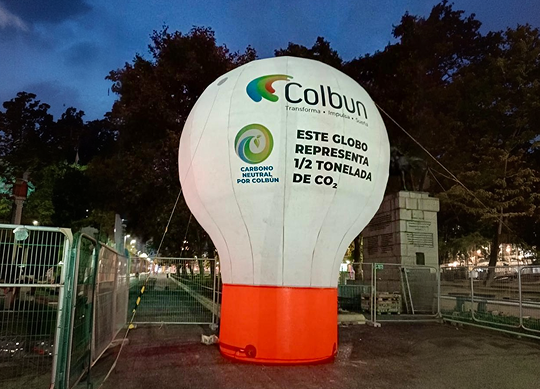
Santiago, April 2026.- This April 26, the Itaú Santiago Marathon will take place, gathering nearly 35,000 runners through the streets of the capital, and for the third consecutive year, it will be carbon neutral. This means measuring and offsetting emissions generated by the use of fossil fuels —gasoline/diesel— whether in vehicles or in energy production for heating and lighting, the transportation of participants, and waste decomposition.
The Santiago Marathon became carbon neutral for the first time in 2024, with the initiative repeated in 2025. The total offset emissions from both races amounted to 6,773 tonnes of CO2e, equivalent to removing 1,800 cars from circulation or planting 64,495 trees.
Colbún's Sustainability and Corporate Affairs Manager, Daniel Gordon, commented: “at Colbún we have set out to contribute with our renewable energy to drive more sustainable sporting events. Being in our third year of neutralizing the marathon, allowing thousands of athletes to participate in a cleaner race, aligns with this goal and fills us with pride. We have also neutralized the Viña del Mar Marathon, the Ironman 70.3 Pucón, the 2023 Pan American and Parapan American Games, and we have a partnership to offset the travel emissions of Team Chile athletes.”
In line with promoting more sustainable sport, this year a preloaded BIP card was included in each runner's kit, encouraging the use of public transportation and thereby reducing emissions associated with race-day travel. “This is part of the path we have been working on for some time toward carbon neutrality, committed to sustainability,” highlighted Francisca Aguirre, Executive Director of the Santiago Marathon.
How the neutralization works
For a marathon to be carbon neutral, all greenhouse gas (GHG) emissions generated by the event must be calculated and offset. To achieve this, GHG emissions are quantified across every stage of the marathon, from organization through runner participation and transportation used.
Once this calculation is completed, emissions are offset using carbon credits. These represent one of the three mechanisms established under the Kyoto Protocol for reducing GHG emissions. They are measured in tonnes of CO2 equivalent and translated into Certified Emission Reductions (CERs).
Each certificate is equivalent to one tonne of CO2 that was not released into the atmosphere and can be traded on the formal carbon market to other entities. In this way, the total amount of gases emitted and offset equals zero, allowing the event to be carbon neutral.