Companies that use Colbún renewable energy grew 45% in two years and total 146 companies from 13 sectors
● The number of companies increased from 101 in 2023 to 135 in 2024 and 146 in 2025, a sustained growth that confirms how renewable energy certification has become a widespread practice in the Chilean economy. The total volume of renewable energy reached 6,500 GWh.
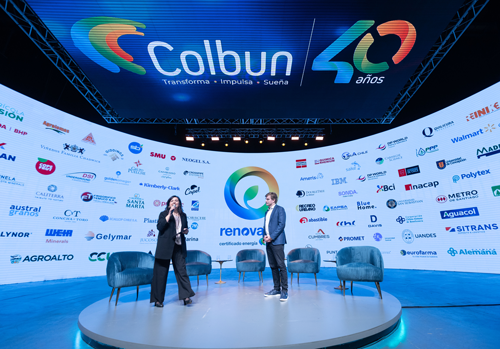
Santiago, June 3, 2026 – In 2023, 101 companies certified their renewable energy use with Colbún. In 2024, that number rose to 135. This year, it reached 146. In two years, the number grew by 45% and diversified across 13 productive sectors, an expansion that the company highlighted during its annual renewable energy certificate ceremony for these companies.
This growth is occurring within an unprecedented context for the Chilean electricity system. During 2025, solar, hydroelectric, and wind energy reached nearly 63% of the total generation injected into the system, a historic record that is expected to continue growing this year.
Against this backdrop, the 146 companies recognized by Colbún collectively certify more than 6,500 GWh of renewable energy consumption, a figure equivalent to 64% of Colbún generation in Chile in 2025. Mining accounts for 5,184 GWh, but the novelty lies in the diversification: certifications now extend to retail, agribusiness, healthcare, education, logistics, technology, manufacturing, forestry, real estate, hospitality, and essential services.
In addition, there is a growing participation of smaller energy companies, including unregulated customers with annual consumption below 1,000 MWh who, driven by conviction and a sustainability strategy, have also opted to certify the renewable origin of their energy. The environmental impact associated with this volume of renewable energy is significant. The certification of 6,500 GWh prevented the emission of more than 1.6 million tons of CO₂, an effect equivalent to taking approximately 427,000 vehicles off the road for a year or planting more than 15 million trees.
Until 2024, Colbún supported certain renewable energy consumption by its customers through external review processes. Starting in 2025, and with the aim of strengthening the traceability, transparency, and consistency of the information provided, the company began using RENOVA, the National Renewable Energy Registry of the National Electric Coordinator, to register supply contracts with renewable attributes that it is required to support through this platform.
With this change, Colbún is moving toward the use of nationally recognized mechanisms that allow it to provide greater support for the renewable energy consumption declared by its customers and contribute to more transparent management of the renewable attributes associated with its supply contracts.
“The fact that we’ve gone from 101 to 146 certified companies in two years, and that this expansion has occurred in sectors as diverse as retail, healthcare, education, and technology, shows that renewable energy has ceased to be a differentiating attribute and has become a cross-cutting part of corporate sustainability, but with a holistic understanding of that sustainability: economic, operational, environmental, and social,” stated José Ignacio Escobar, CEO of Colbún.
Among the recognized companies are Codelco, Minera Escondida, Collahuasi, Metro, Polpaico, Ripley, Clínica Alemana, BCI, CCU, Concha y Toro, INACAP, and the University of Concepción, distributed from the mining region in the north to the southern part of the country.
During the event, a discussion was held under the title “A Sign of Confidence” focusing on the challenges of business management in a context of high uncertainty and volatility. Participants included Francesca Milani, president of Acenor (Association of Non-Regulated Electrical Companies); Holger Paulmann, president of Icare and CEO of Sky Airlines; Bernardo Larraín, president of CMPC and vice president of Colbún; and journalist Angélica Bulnes.
Colbún's progress in this segment is also framed within a rapidly expanding market of deregulated customers: Chile now has more than 2,500 deregulated customers, a figure that has grown steadily as companies with consumption exceeding 300 kW seek to stabilize costs and decarbonize their operations. During 2025, Colbún signed contracts for 846 GWh annually with 92 new customers, including renewable energy supply agreements with Aguas Andinas, Parque Arauco, and Grupo SMU.